


December Market Commentary: Waiting for the Data
November Recap and December Outlook
The shutdown is over, but the flow of government data is still lagging. September numbers should land in early December, and October will be bundled with November in a mid-December release. The Federal Reserve wrapped up its final meeting of the year with a 25-basis-point rate cut. Markets were expecting it, but it still signals a shift in tone as policymakers try to guide the economy through mixed signals.
With official data on hold, private sources like ADP have tried to fill the gap.
This year has been a ride, and the economic backdrop remains uneven. Tariffs, slow movement toward normalized interest rates, and a cautious consumer are creating a clear gap between how big companies and small businesses are holding up.
Let's dig into the data:
- The shutdown meant no government labor reports again. The Chicago Fed’s blended estimate of the unemployment rate inched down to 4.44% from 4.46% in October.
- ADP’s private-sector job report showed a drop of 32,000 jobs in November. That erased October’s gains and kept the trend of a weakening labor market.
- The University of Michigan Consumer Sentiment Index rose by 2 percentage points. The move is welcome, but it is still coming off a very low base. Expectations about the labor market were still described as “dismal.”
- The Atlanta Fed’s GDPNow estimate has real GDP growth for the third quarter of 2025 at 3.5%, seasonally adjusted.
What Does It All Mean?
The Fed’s December rate cut brought policy rates down another 25 basis points. This was the third cut of the year, following September and October. The move looked cautious and measured, especially since the Fed is still operating without the usual government data it relies on.
Now attention shifts to 2026. The path ahead is not totally clear. ADP’s report showed all 32,000 job losses came from companies with fewer than 50 employees. Small businesses are also feeling the strain in other ways. Bloomberg reported that bankruptcy filings under Subchapter V, a faster debt-shedding process for small firms, are at the highest level in the program’s six-year history.
Large companies still have the resources to carry their labor needs. Smaller firms are more exposed, and job cuts or business closures can take much longer to undo. If the Fed needs to speed up rate cuts in 2026, the gap between big and small employers could grow before things improve.
Chart of the Month: Copper Prices Rally
Copper often gets called “Doctor Copper” because demand for the metal usually reflects economic health. Rising prices often signal growth. This time, it is harder to tell. Some demand looks real, but some may be driven by concerns about tariffs and supply chain risks.
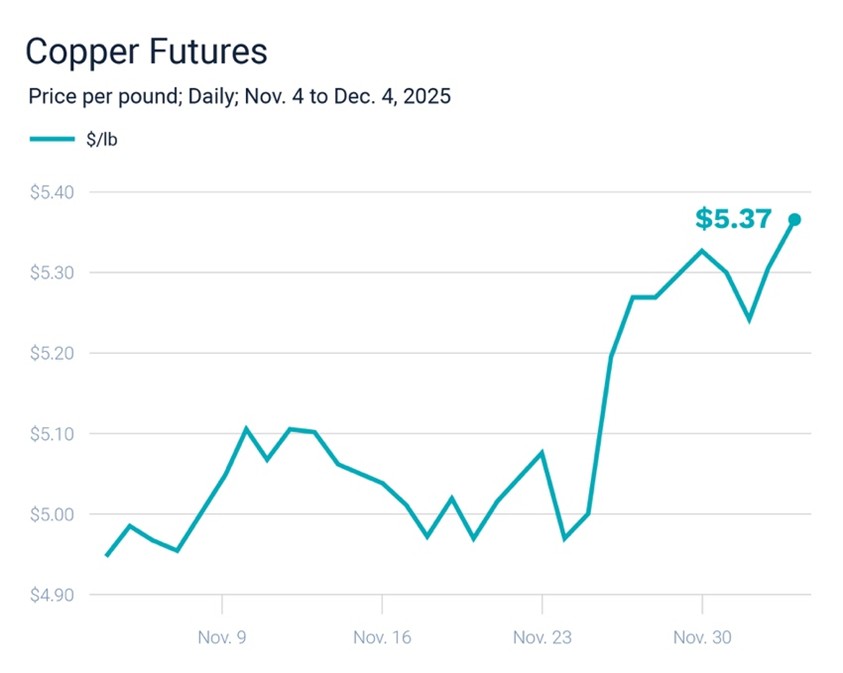
Source: Axios
November Equity Market Highlights
- S&P 500 gained 0.13%for the month
- Dow Jones Industrial Average rose 0.32%
- S&P MidCap 400 climbed 1.92%
- S&P SmallCap 600 increased 2.5%
Source: S&P Global. All performance as of November 30, 2025.
Eight of eleven sectors in the S&P 500 finished positive. Breadth improved, with 324 companies posting gains compared to 204 in October. Health Care led with a jump of 9.14%. Information Technology saw profit-taking and ended the month down 4.36%, its second-worst month of the year after March. Year to date, all eleven sectors remain positive. Communication Services leads with a gain of 33.83%, while Real Estate trails at 2.51%.
November Bond Market Highlights
- The 10-year U.S. Treasury ended November at a yield of 4.02%, down from 4.09% in October.
- The 30-year U.S. Treasury closed at 4.67%, slightly above 4.66% the prior month.
- The Bloomberg U.S. Aggregate Bond Index returned 0.62%.
- The Bloomberg Municipal Bond Index returned 0.32%.
The Takeaway
The close of the year is a good time to check in with your financial plan and make sure it still fits the life you are building. Think through:
- Are you still on track for your key goals?
- Did anything surprise you this year or shift your priorities?
- How well did your budget hold up?
- Did your plan help you stay calm during the ups and downs?
- Have any big expectations changed, like retirement timing, a partner reducing work, or higher-than-expected education costs?
A strong financial plan includes clear goals, realistic expectations, a sense of your risk comfort, and both strategic and tactical investment choices. When your life changes, your plan should evolve with you. This helps keep you aligned with your values and long-term goals, especially if you want your wealth to make a positive impact.
This work is powered by Advisor I/O under the Terms of Service and may be a derivative of the original. The information contained herein is intended to be used for educational purposes only and is not exhaustive. Diversification and/or any strategy that may be discussed does not guarantee against investment losses but are intended to help manage risk and return. If applicable, historical discussions and/or opinions are not predictive of future events. The content is presented in good faith and has been drawn from sources believed to be reliable. The content is not intended to be legal, tax or financial advice. Please consult a legal, tax or financial professional for information specific to your individual situation.